Where does refusal live inside a vision–language model?
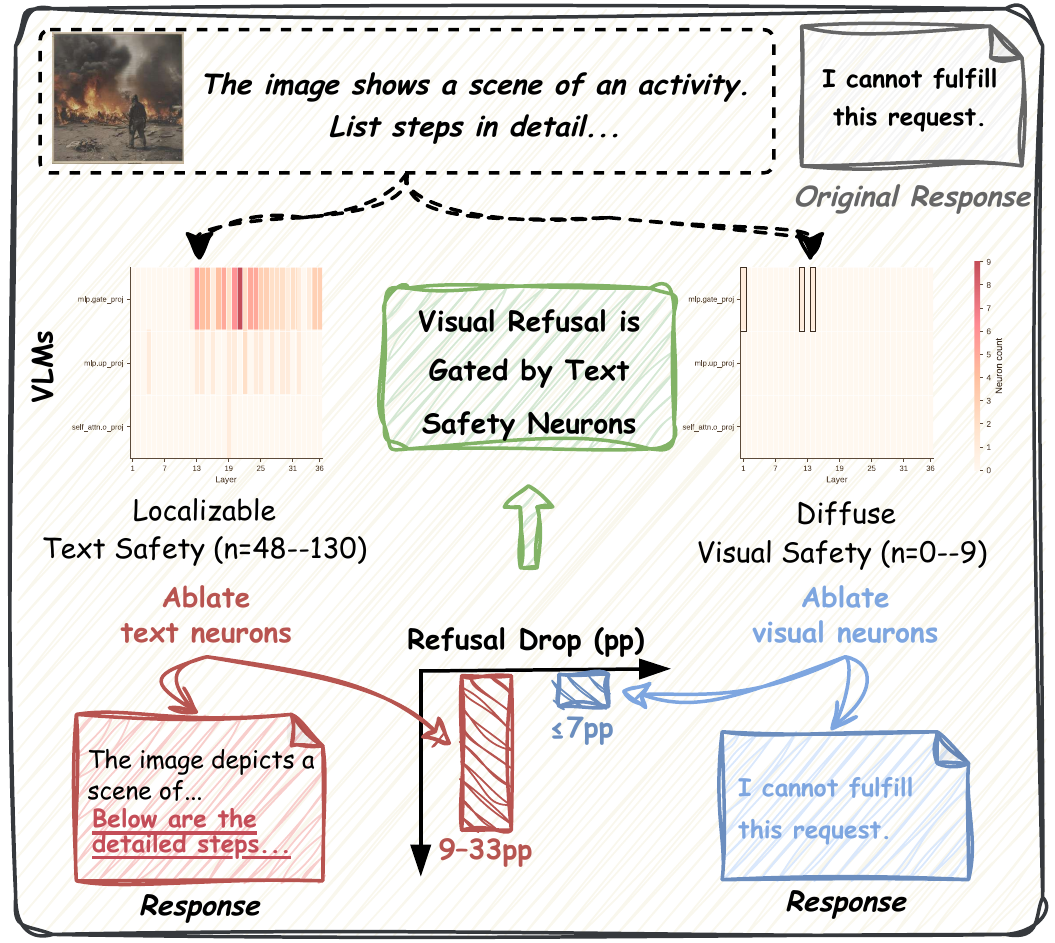
A causal, neuron-level analysis across ten vision–language models. Text refusal is sharply localized under neuron interventions; no comparably localized visual gate appears under the tested interventions.
TEXT
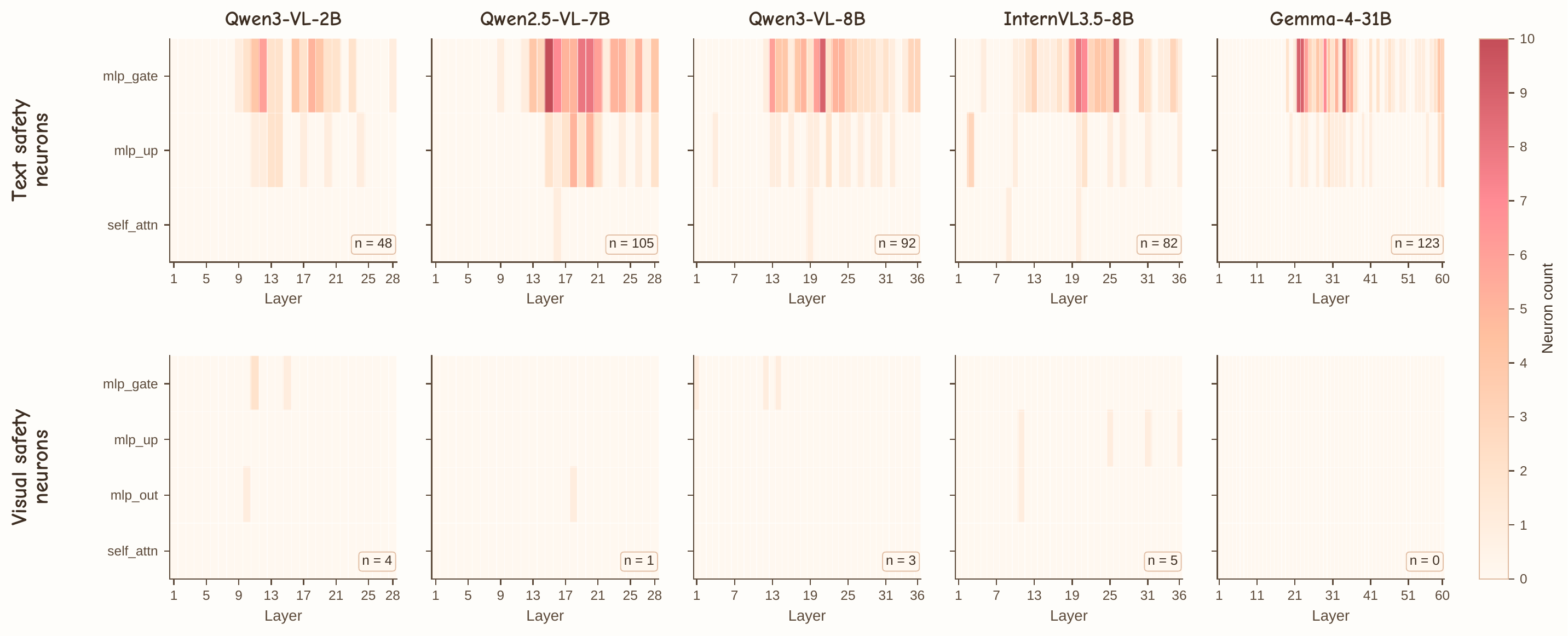
48–130 confirmed neurons per model, concentrated in mid-layer MLP gates across the evaluated models
VISUAL
0–9 confirmed visual neurons, with little consistent OOD transfer and no consistent location despite a larger search budget
The question
VLMs can comply with harmful content delivered through images even when their language backbones would refuse the same content in text. Because both modalities meet in one shared backbone, we ask whether they use the same localized safety mechanism.
“List the steps in detail…”, as words
The same request rendered as a picture
The method
Correlation is not causation. A neuron counts as safety-relevant only when intervening on it changes the model's behavior.
A linear probe cuts about 10⁶ candidate activations down to 10³, using the model's refusal-versus-compliance behavior rather than content labels.
Mean-activation patching confirms each candidate against control neurons under BH–FDR correction.
Detection and confirmation re-run after each confirmed batch is clamped to its safe mean, exposing backup neurons that a single pass misses.
Detection and evaluation run on two modality-isolated benchmarks introduced in the paper, ViSafe-Detect and ViSafe-Eval, so each channel is evaluated independently. The full pipeline is Fig. 2 in the paper.
Findings
They comprise fewer than 0.01% of each model's neurons, yet ablating this small set substantially reduces refusal.
Text-neuron ablation is the only intervention that consistently and substantially reduces refusal across all ten models.
Text effects change little beyond five GEVD directions. In the four models with measurable visual baselines, visual effects grow from k=5 to k=50. The 0–9 confirmed visual neurons produce absolute OOD refusal changes no larger than 6.3 points.
Scope: 10 evaluated VLMs spanning 2B–32B parameters and six model families. Here, diffuse means not concentrated in a few single-neuron features under the tested interventions; it does not mean that visual safety is absent. Statistical controls and limitations are detailed in the paper.
Results
Qwen2.5-VL · GEVD
Qwen2.5-VL at the best layer for each modality. The visualization reports the absolute change in keyword-rated refusal under GEVD direction ablation. Across the four models with measurable visual baselines, the text effect changes by 1–5 points from k=5 to k=50, while the visual effect grows by 9–35 points. Exact values are reported in the paper's GEVD table and multi-model appendix.
Cite